
 Neal C
Neal Carter Mountaineer
- Neal Carter Mountaineering Highlights
- First Ascents by Neal Carter
- 1920: Black Tusk North Pinnacle
- 1922: Second Ascent of The Table
- 1923: Carter/Townsend Expedition
- 1932: Mount Meager Expedition
- 1933: To the Cradle of Toba River!
- 1934: Mount Waddington Tragedy
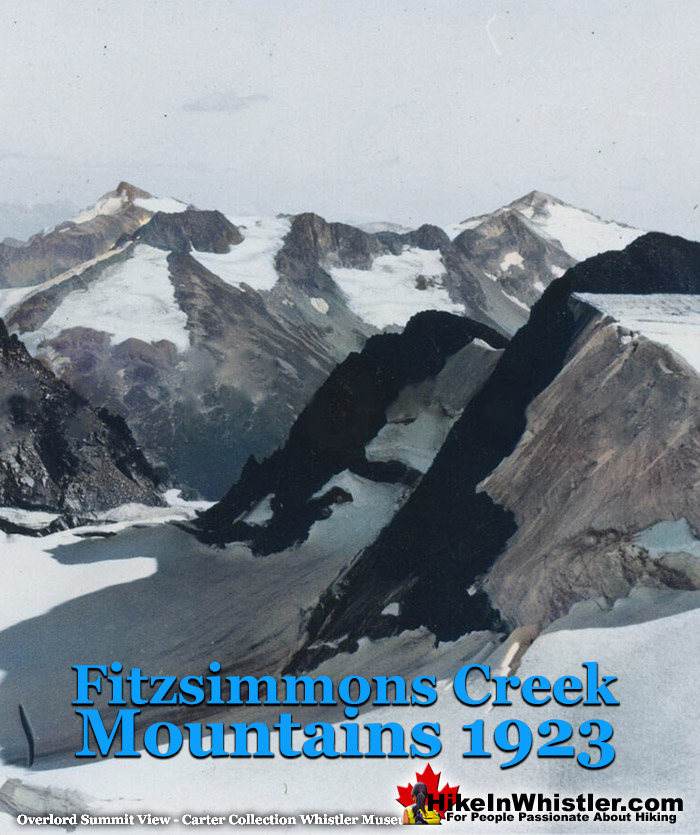
In the summer of 1923 Neal Carter and Charles Townsend went on an incredible two-week climbing expedition that was recorded in detail and expertly photographed. Wedge Mountain, the strikingly wedge-shaped mountain next to Blackcomb Mountain was first climbed by them, and the following days they pressed on through unknown glaciers to summit and name Mount James Turner. Mount James Turner is the third highest mountain in Garibaldi Provincial Park at 2703 metres(8868 feet). It is only surpassed by Wedge Mountain at 2892 metres(9488 feet) and Wedge's neighbour Mount Weart 2835 metres(9301 feet). Mount James Turner is quite a remote mountain in Garibaldi Park and takes about 8 hours to reach it from Wedge Mountain. Remarkably, this expedition was documented by both Townsend and Carter, as well as photographed by Carter. Despite the largely uncharted terrain which involved bushwhacking, large creek crossings, treacherous, unknown mountains and numerous glacier crossings, the story reads as a relatively mild walk in the woods. Certainly they were extremely tough, skilled and fearless mountaineers that had a love of exploring mountains that is inspiring to read. Hearing the word for word account gives you the beautiful sense that you are with them on their journey through these mountains as they were first climbed. Charles Townsend wrote two articles about their two week expedition in the BC Mountaineer newsletter. The first in October 1923 with the title, 'Trip to Wedge Mountain and Mt. Turner'. The second, 'Fitzsimmons Creek Mountains', was printed in November 1923. His articles are shown below in bold. Neal Carter's photographs have been added to the article as well as dates and headings to clarify where they were on each day. Neal Carter's black and white photos have been partially colorized to enhance their appearance.
BCMC Newsletter November 1923
FITZSIMMONS CREEK MOUNTAINS
By Chas. T. Townsend
September 15, 1923: Alta Lake to Fitzsimmons Cabin
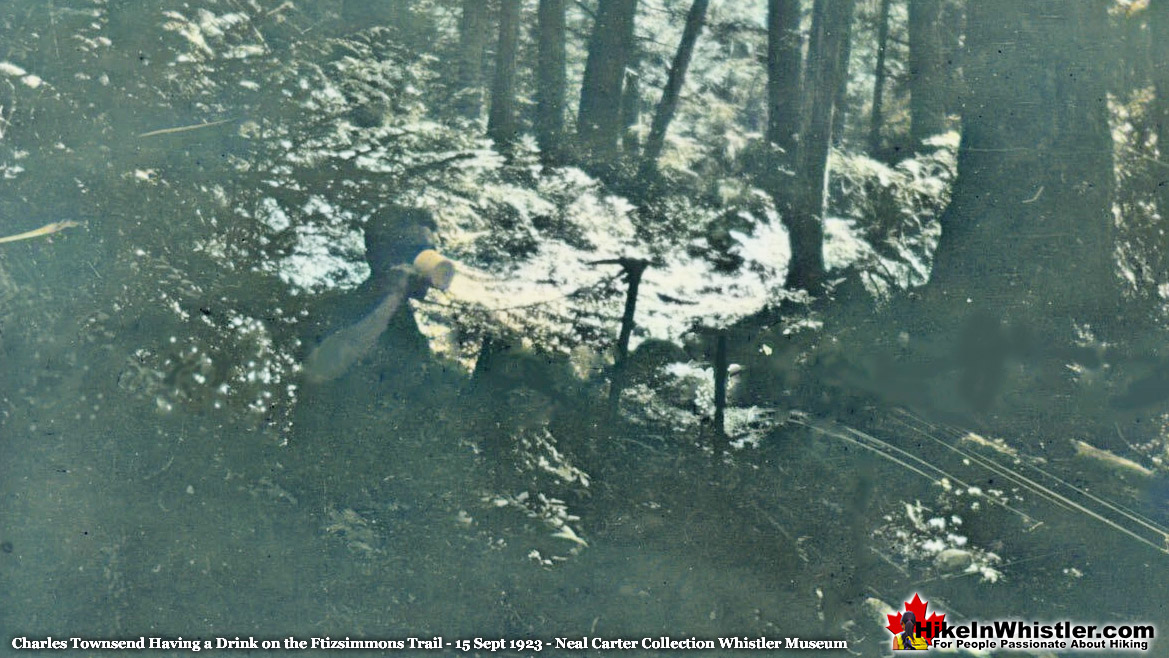
We left Rainbow Lodge at 11 a.m. and found the trail up Fitzsimmons Creek was excellent to travel on, and, but for some exciting moments with wasps’ nests, we had an enjoyable day’s journey to the cabin on the meadows below Avalanche Pass. The two miners we found to be not at home, so we made ourselves comfortable in their absence.
Charles Townsend Fitzsimmons Trail 15 Sept 1923
September 16, 1923: The Fissile, Refuse Pinnacle and Overlord
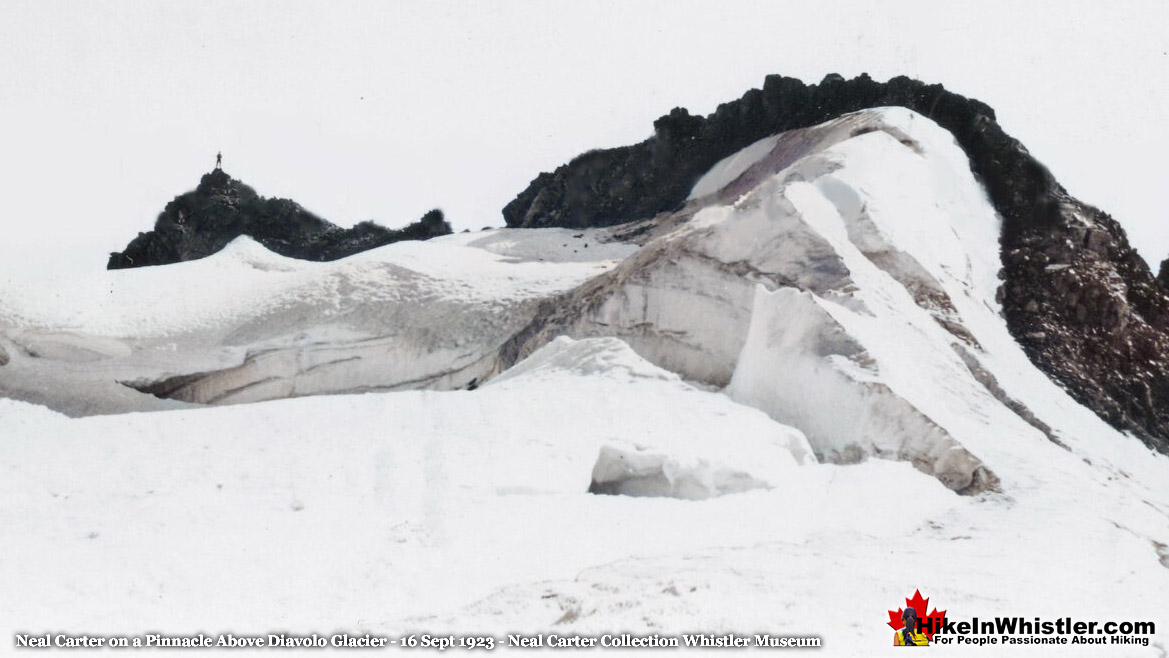
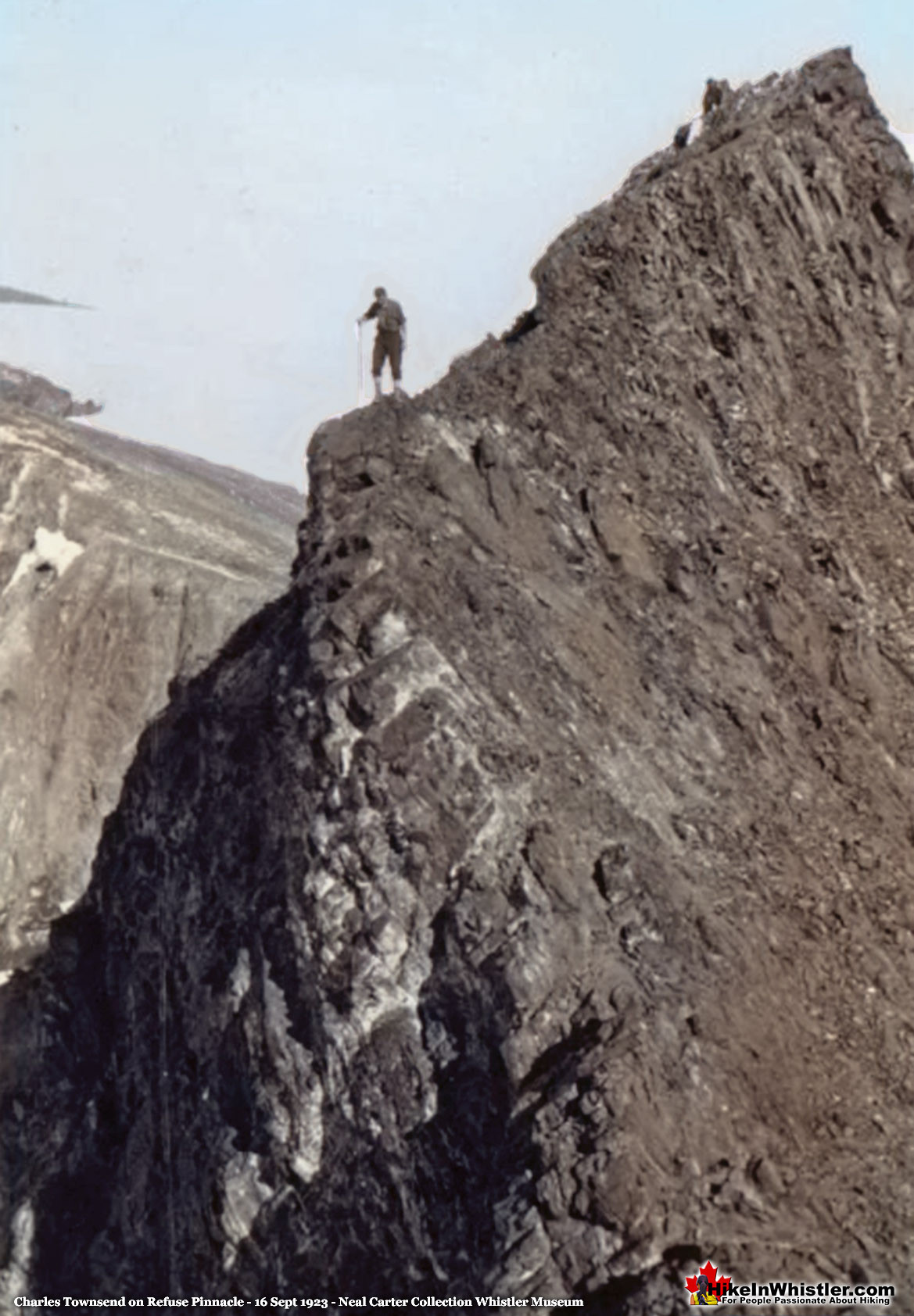
The next day we spent in climbing Mt. Overlord, which had been climbed for the first time by Mr. and Mrs., Munday a few months earlier. They had much more snow for their climb, and were able to go up the Fitzsimmons Glacier from the base of Red Mountain. Owing to the opened up condition of the ice, however, we thought it better to keep to the rocks as much as possible. To avoid the glacier we climbed the east peak of Red Mountain, which connects with Mt. Overlord by a narrow ridge, composed of a series of sharp pinnacles. The rocks were so rotten on this ridge that we called the largest pinnacle “Refuse Pinnacle,” on account of the trouble it gave us in circumnavigating it. Once round this, we got on to the neve of a small glacier, and a short walk took us to the summit of Mt. Overlord.
Neal Carter on Pinnacles Leading to Overlord 16 Sept 1923
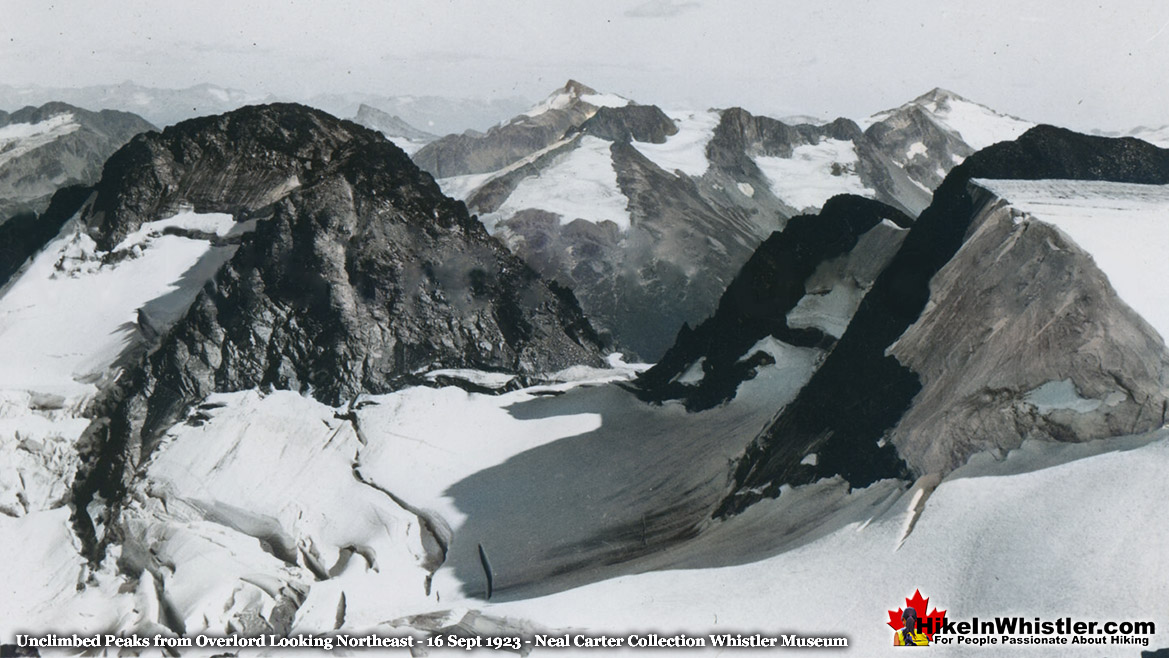
Once again we were blessed with a very clear day, and we secured an excellent panorama of the Garibaldi district and the Pitt River mountains, The large Cheakamus Glacier with its huge ice-fall showed up particularly well, and in the distance we could see Mt. Cathedral, of the local mountains, and Mt. Baker in the far distance. Some of the peaks to the east of Mt. Overlord looked as though they might give us some good climbs, one in particular, not far from where we were, looking very inviting.
Peaks from Overlord Looking Northeast 16 Sept 1923
We had no more time that day though, so we went back to the cabin. On our way back we found it easier to go over the top of Refuse Pinnacle, and to drop down to the glacier at the foot of it. We crossed the neve of this to Red Mountain, where we picked up our tracks of the morning.
Charles Townsend on Refuse Pinnacle 16 Sept 1923
Our sleep that night, and every night we spent at the cabin, was seriously disturbed by a couple of large pack rats and a number of mice, which kept up an incessant clatter among the pots and pans, and knocked over everything moveable. The last night we were there it turned much colder, and the pack rats carried a large portion of our firewood from behind the stove to the floor under our bunk, where they were evidently trying to make a nest.
September 17, 1923: Whistler Mountain
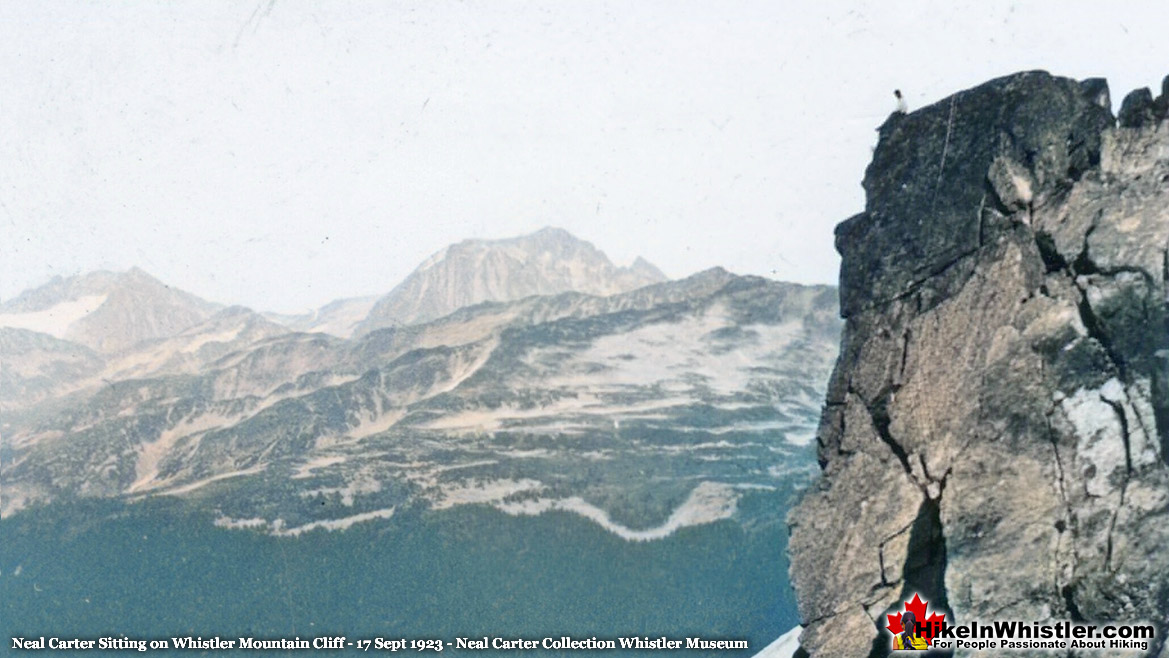
On Monday, September 17th, we made a half-day trip to Mt. Whistler. The top is a series of mounds, and it takes some time to find out which is the highest. From the highest point we had a fine view of Rainbow Valley, and the Garibaldi district tempted us to photograph it again, Mt. Whistler is said to be 7,200 feet in height, but it did not seem to us to be any higher than Helmet Peak, 6,800 feet.
Charles Townsend Whistler Mountain 17 Sept 1923

September 18, 1923: Fitzsimmons Cabin to Mount Diavolo
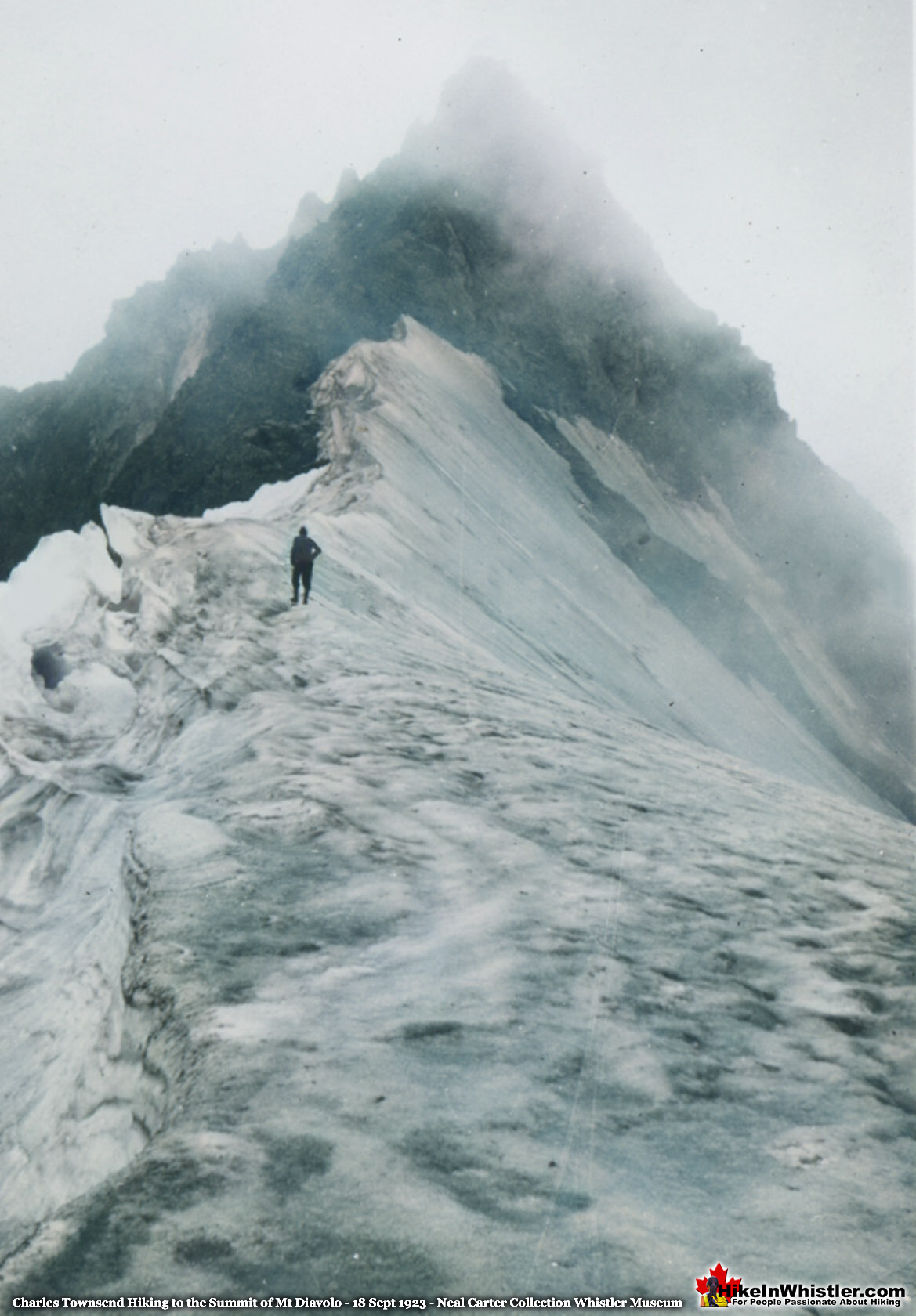
The next day we set out to climb the peak we had seen from the top of Mt. Overlord. We followed our old tracks over Fitzsimmons Glacier and Refuse Pinnacle until we came to the glacier just below the peak of Mt. Overlord. We crossed this in an easterly direction until we came to some pinnacles on a ridge running east from the peak we had just left. The weather up to now had been growing more and more threatening and cold, and at this point the clouds descended on us like a thick fog, accompanied by a high, cold wind, which, however, did not disperse them. We followed the rocks downward towards our objective, of which we occasionally caught a glimpse, and we soon discovered that the only way we could climb it was to cross a knife-edge ridge of ice about 150 feet long, and then find a way up the rocks. Crossing the ice took us some time, as we had to cut steps, Neal breaking his ice-axe in the process.
Charles Townsend on Ridge to Diavolo Peak 18 Sept 1923
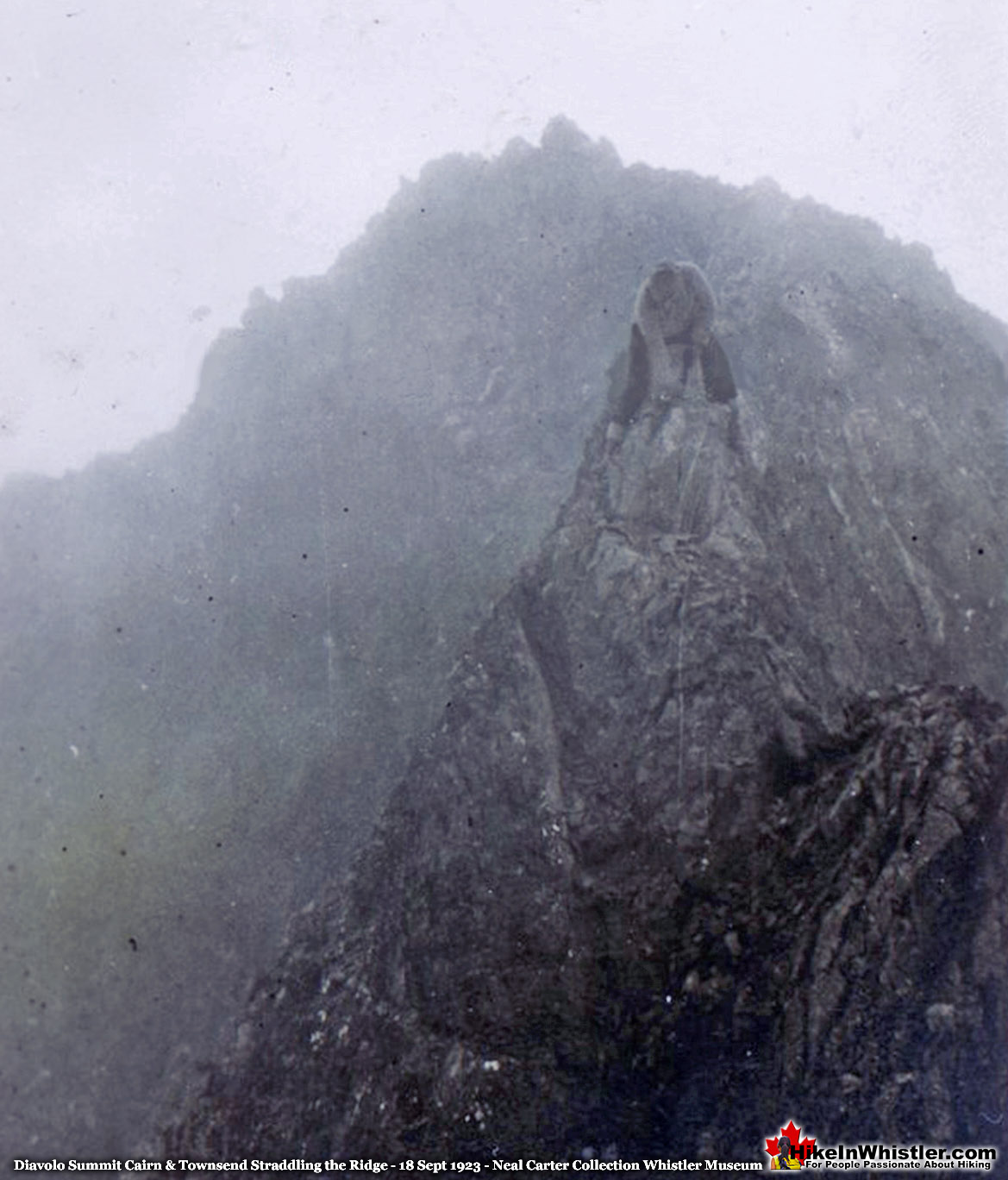
The rocks were loose, as usual, and we had an exciting climb to what we thought was the top. We were mistaken, however, for the top was about fifty feet away and about ten feet higher. The only way to it was along a very sharp knife-edge, which we had some trouble in negotiating. Once on top we hurriedly built a cairn, and retraced our steps as soon as possible, for it was bitterly cold. The peak we named Mt. Diavolo, owing to its character and the weather conditions under which we climbed it. Its height we estimated to be about 7,700 feet.
Charles Townsend Straddling Diavolo Summit 18 Sept 1923
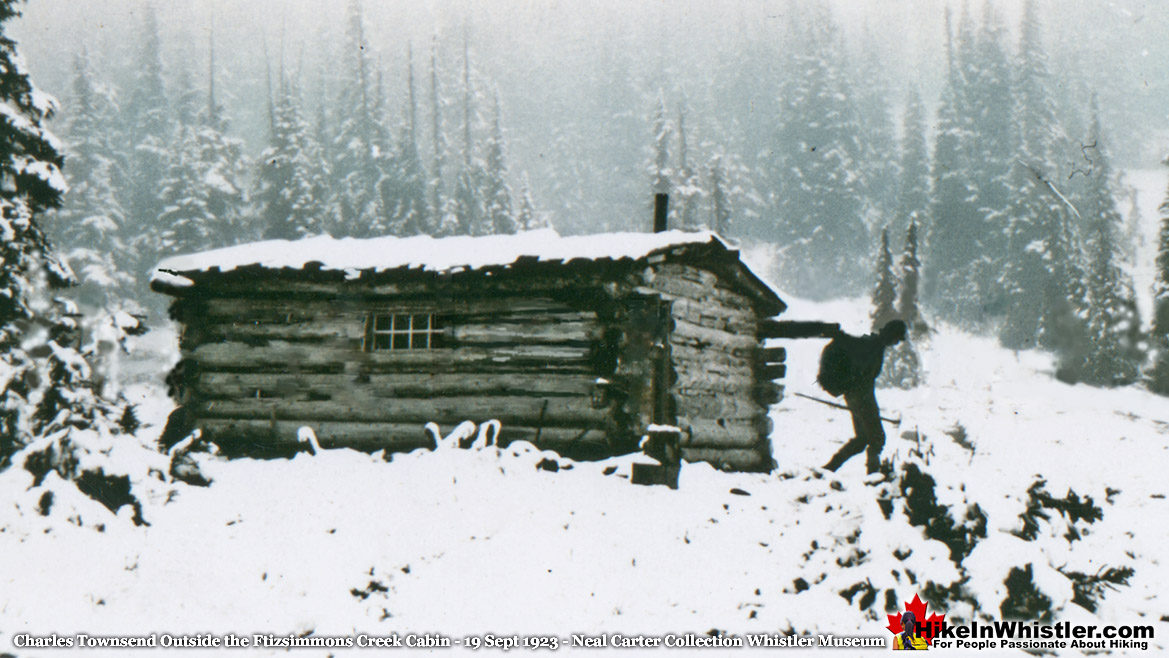
September 19, 1923: Fitzsimmons Cabin Rain Turned to Snow
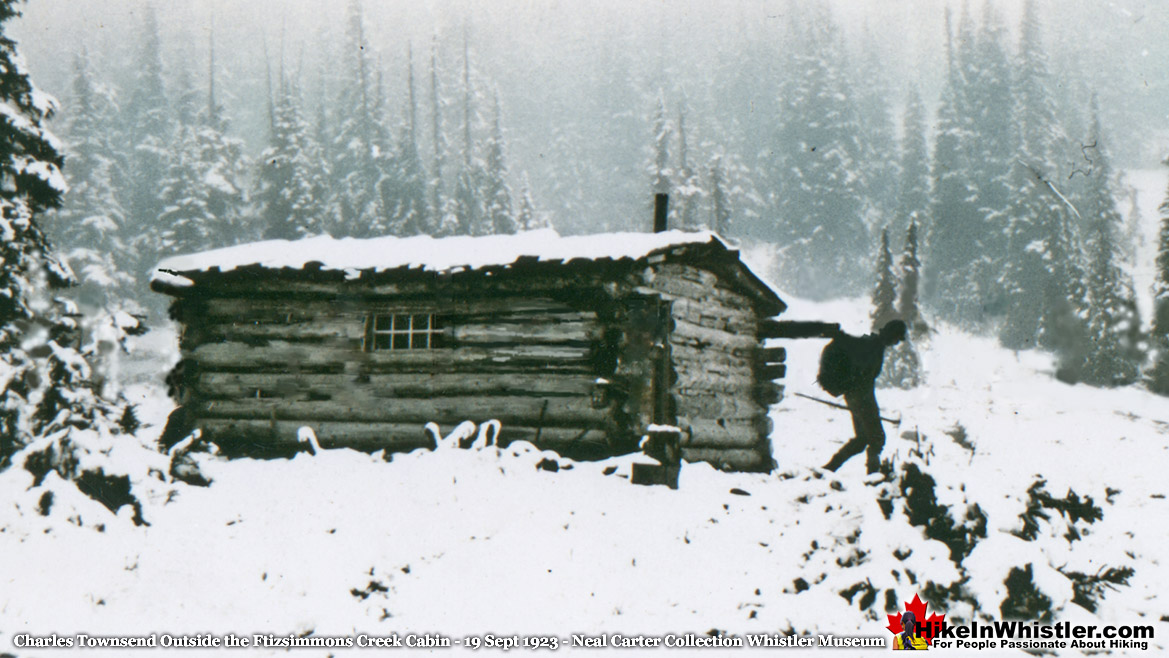
Townsend didn't write about September 19th as it was spent in the cabin avoiding the bad weather.
Charles Townsend Fitzsimmons Cabin 19 Sept 1923
September 20, 1923: Fitzsimmons Cabin to Alta Lake
The next day (19 Sept) it began to snow, keeping up until we left the day after (20 Sept), by which time there was about two inches of snow on the ground.
Whistler Museum's Virtual First Ascent of Mount Diavolo
This is the third of three videos created by Jeff Slack for the Whistler Museum depicting the amazing journey Carter and Townsend went on when they explored the Fitzsimmons Valley to the peaks of Mount Overlord. This one is titled, The 1st Ascent of Mount Diavolo - A Virtual Tour. Using the words of Charles Townsend and the photos of Neal Carter, the video shows the journey with the use of Google Earth.
Neal Carter's Article in The Vancouver Sun 30 Sept 1923
Neal Carter also wrote about the expedition which appeared in the Vancouver Sun in the September 30th, 1923 edition. His excellent article is titled 'Rugged Peaks are conquered in BC Wilds' can be found here.
1925: Fighting Way to Mt. Tantalus
September 15, 1923: Alta Lake to Fitzsimmons Cabin
Carter's article doesn't include details about their hike up Whistler Mountain on the 15th. Charles Townsend wrote a short description of the day in his BC Mountaineer article: "The following morning, we left Rainbow Lodge at 11am and found the trail up Fitzsimmons Creek was excellent to travel on. But for some exciting moments with wasp nests, we had an enjoyable day's journey to the cabin on the meadows below Avalanche Pass. The two miners we found to be not at home so we made ourselves comfortable in their absence."
September 16, 1923: The Fissile, Refuse Pinnacle and Overlord
On Sunday we made the ascent of Mt. Overlord, second highest in the group, by way of going around the rear of Red Mountain and over a series of pinnacles on the ridge leading up to Mt. Overlord.
Neal Carter on Pinnacles Leading to Overlord - 16 Sept 1923
One in particular on one side was a sheer drop to the Fitzsimmons Glacier hundreds of feet below, while the back was a veritable ore-dump consisting of strips of granite, quartz, slate, iron ore, etc., all broken up into small pieces by the frosts and left in a pile at the “clinging angle”. This we refer to as “Refuse Pinnacle”.
Charles Townsend on Refuse Pinnacle - 16 Sept 1923
Mt. Overlord’s summit closely resembles that of Wedge, and is perhaps a little over 8000 feet. Mr. and Mrs. Munday’s record was found, and ours added to it. The view to the north and south is not so striking.
Peaks from Overlord Looking Northeast - 16 Sept 1923
RETURN IS SIMPLIFIED
After climbing a few odd-shaped pinnacles around the rim of the glacier on Overlord, the return trip was simplified by going around the bottom of the pinnacles beyond Refuse Pinnacle on the glacial neve.
September 17, 1923: Whistler Mountain
Although not a strenuous trip, we decided to take the next day easy and made an ascent of Whistler Mt. from the cabin. This is most easily reached from Alta Lake, which it overlooks, and is frequently ascended from the lodge, and made a pleasant afternoon’s trip..
Neal Carter Whistler Mountain - 17 Sept 1923
September 18, 1923: Fitzsimmons Cabin to Mount Diavolo
Tuesday the weather showed signs of breaking and we hurried to get in our last trip. From K.M. pinnacle back of Mt. Overlord, I had seen a sharp peak connected to where I was by a knife-edge ice ridge above which a rock arete led to the summit. This was so narrow that sections of it looked as if they could be pushed over, and promised so interesting a climb that Mr. Townsend named it Mr. Diavolo from its black and sinister appearance, and we determined to try this peak today.
CLIMBING IN DANGER
Taking advantage of a momentary rift, a photo was taken and a start made immediately, ice steps had to be cut up the steep ice ridge and when within four steps from the top, my ice-axe cracked and almost broke in two while cutting, very nearly throwing me off my balance and providing rapid transit to the Diavolo Glacier far below. Finishing these few steps with Mr. Townsend’s axe, we stepped onto the rock and began one of the most exciting bits of rock climbing. It is best compared with the summit arete of Mt. Tupper in the Selkirks. Fog hid from us the full extent of the tremendous drops on either side in case a hand or foothold should give away. Fifty minutes later the top of the arete was reached, after a climb of only two or three hundred feet.
Charles Townsend on Ridge to Diavolo Peak - 18 Sept 1923
Here we were much disappointed to find the real summit, a few feet higher, some 50 feet away, connected by a practically level series of knife-edged pinnacles of rock. After some debate in which the lateness of the hour entered into consideration, I started off to work my way along astraddle the ridge, the only indication of Mr. Townsend’s presence behind being a clatter of rocks back in the fog as sections of the ridge would topple over and go avalanching down to the glaciers on either side below. Loosened by me while testing them, he would knock them over to avoid trouble on the return. The summit cairn was finally erected at 2:45 and the name Diavolo heartily verified. Although only 7700 feet in elevation, it amply repaid our search for a rock climb.
Charles Townsend Straddling Diavolo Summit - 18 Sept 1923
On a clear day a wonderful panorama of the mountains around the head of the Pitt River might be obtained, as well as the Cheakamus Glacier, the largest in the region, consisting of one continuous ice-fall from the base of Mt. Castle Towers to almost the level of Cheakamus Lake, 4000 feet below. With the aid of the rope, we negotiated the return safely, and following our footsteps over the fog covered glaciers, made good time by reaching the cabin about 6:30. Soon after in commenced to rain, and the following day was spent inside.
September 19, 1923: Fitzsimmons Cabin Rain Turned to Snow
We saved food by laying in bed most of the morning reading; however, by night we had almost come to the stage of hiding our food from each other, and if a raisin dropped on the floor, it was a case of get a candle and hunt for it. Snow began to fall in the afternoon, and we awoke next morning to find 2 ½ inches had fallen and part of our firewood, cut in five-inch lengths, packed away under the bed by packrats.
Charles Townsend Outside Fitzsimmons Creek Cabin - 19 Sept 1923
September 20, 1923: Fitzsimmons Cabin to Alta Lake
So we took the hint and after a somewhat imaginary breakfast, left for Alta Lake. That night we had a real supper at the lodge and after a few hours sleep, caught the early morning train (21 Sept Friday) and arrived back in Vancouver at 10:30 am highly pleased with our mountaineering holiday. Lots of goat tracks seen, but few evidences of bear. Only animals actually seen were marmots and a porcupine at the cabin.
Whistler Museum's Virtual First Ascent of Mount Diavolo
This is the third of three videos created by Jeff Slack for the Whistler Museum depicting the amazing journey Carter and Townsend went on when they explored the Fitzsimmons Valley to the peaks of Mount Overlord. This one is titled, The 1st Ascent of Mount Diavolo - A Virtual Tour. Using the words of Charles Townsend and the photos of Neal Carter, the video shows the journey with the use of Google Earth.